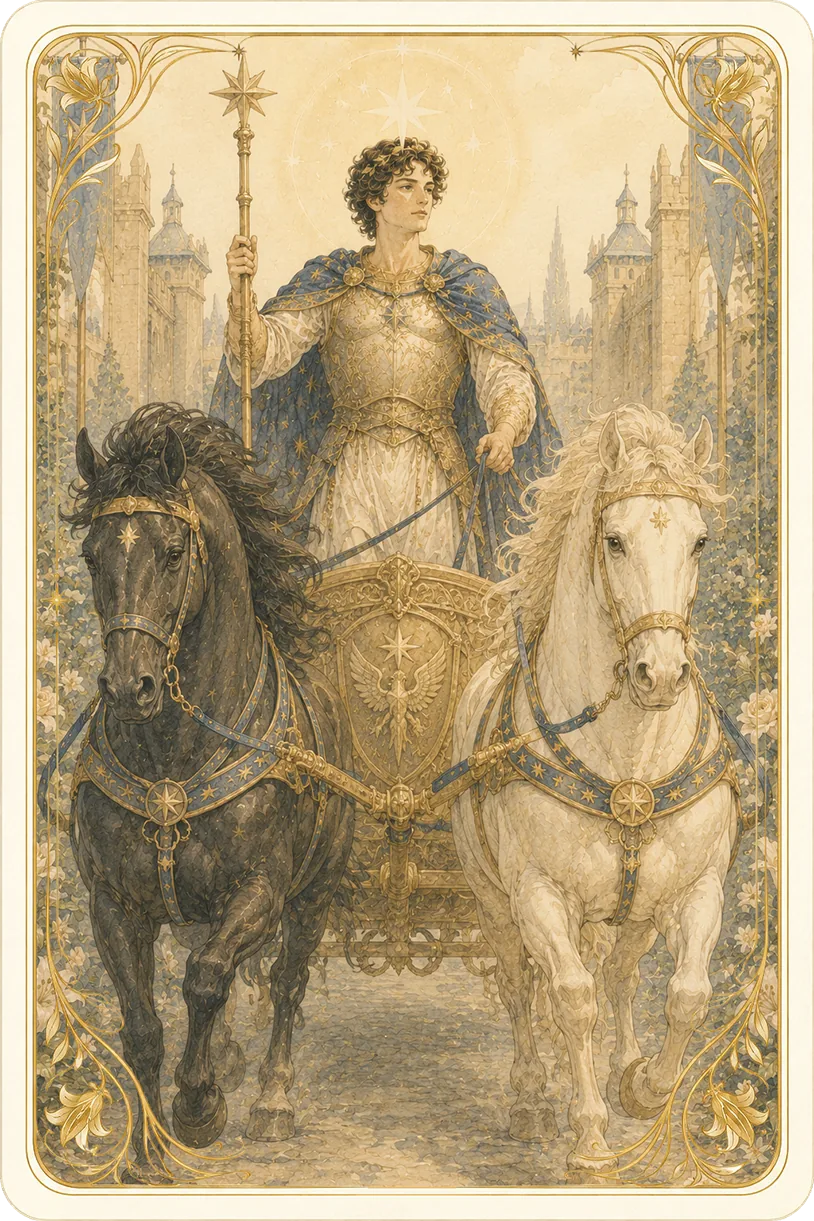
The Chariot
The Chariot is about steering, not speed. Competing pressures pull in different directions, and progress comes from harnessing them toward one destination you've actually chosen rather than one you drifted into.
KeywordsVictory, drive, willpower, control, goals, movement, competition, focus
The Chariot is about steering, not speed. Two sphinxes pull in different directions and the driver holds no reins — progress comes from harnessing competing pressures toward one destination you have actually chosen, rather than one you drifted into.
Upright meaning
Upright, momentum returns. Things you'd been putting off suddenly feel possible, and you're willing to hold your position under pressure. The card's strength isn't raw force — it's coordination: getting your nerves, your schedule, and other people's expectations pointed the same way. Literal movement often shows up too, from a relocation to travel to a change of environment. Discipline here feels less like restriction and more like traction.
Reversed meaning
The reins have loosened. That might mean effort without direction — a lot of activity you couldn't summarize if asked why — or winning so hard that you've stopped noticing who you left behind. Sometimes it's the opposite: the engine won't start and you're stalled at the beginning. Rewriting the destination usually helps more than pressing the accelerator. Slowing down long enough to aim is not the same as giving up.
Love & relationships
You may be the one driving — initiating, defining, pushing for an answer. That energy can be attractive, but it turns into pressure fast if the other person is moving at a different pace. Agreeing out loud on where you're both headed prevents most of the friction here.
Work & money
A push toward a result: deadlines, bids, targets, anything where sustained focus decides the outcome. Financially, staying inside a plan you set while calm works better than reacting to a moment. The card rewards controlled effort more than bold gestures.
Advice
Before speeding up, write your destination in one sentence. If you can't, that's the work for today.
What the Chariot card looks like, and why it matters
An armoured figure stands in a stone chariot under a starred canopy, a city wall behind them, a river beyond. Two sphinxes — one black, one white — sit at the front, facing slightly away from each other. The driver holds a wand but no reins. The chariot has no visible wheels turning; the whole scene is still.
The missing reins are the point. The driver is not controlling the sphinxes by force; they are held by will, by the fact of the driver's attention being where it needs to be. The two sphinxes facing apart are every competing pull in a life — duty and desire, the thing you should do and the thing you want — and the card's claim is that they can be pointed the same way. Not reconciled. Pointed. The Chariot does not resolve the tension. It drives through it.
The Chariot upright: meaning in a reading
Upright, momentum returns. Things you had been putting off suddenly feel possible, and you are willing to hold your position under pressure. The card's strength is not raw force — it is coordination: getting your nerves, your schedule, and other people's expectations pointed the same way for long enough to arrive somewhere.
Literal movement often shows up too, from a relocation to travel to a change of environment. Discipline under this card feels less like restriction and more like traction: the effort has somewhere to go, and you can feel it going there. The Chariot is the card of the week everything finally moves, and its only demand is that you decided where to before you started.
The Chariot reversed: what changes
Reversed, the reins have loosened. That might mean effort without direction — a lot of activity you could not summarise if someone asked why — or winning so hard that you have stopped noticing who you left behind. Sometimes it is the opposite: the engine will not start and you are stalled at the very beginning, all that force with nowhere to put it.
Rewriting the destination usually helps more than pressing the accelerator. The reversed Chariot is the card of the person who is very busy and quietly lost, and its advice is to stop long enough to aim. Slowing down to choose a direction is not the same as giving up. It is the only thing that makes the speed worth anything.
The Chariot in love and relationships
In love, you may be the one driving — initiating, defining, pushing for an answer. That energy can be attractive; it reads as certainty, and certainty is appealing. But it turns into pressure fast if the other person is moving at a different pace, and the Chariot's failure mode in love is arriving at the destination alone.
Agreeing out loud on where you are both headed prevents most of the friction here. If you are asking about someone new, the card suggests things will move quickly and asks whether you want them to. If you are in an established relationship, it is the card of the shared goal — the move, the plan, the thing you are building together — and the reminder that two sphinxes pull better when they have both agreed on the city.
The Chariot in work, career and money
At work the Chariot is a push toward a result: deadlines, bids, targets, anything where sustained focus decides the outcome. It is a strong card for the final stretch of a project and for any situation where the plan exists and the job is to execute it without flinching. It favours the person who can hold the line when the room gets loud.
Financially, staying inside a plan you set while calm works better than reacting to a moment. The Chariot rewards controlled effort more than bold gestures — the regular contribution made regardless of the headlines, the decision you committed to before the pressure arrived. It is not a card for changing course mid-stream unless the course was wrong; it is a card for driving the course you chose.
The Chariot as a yes-or-no card
Asked yes or no, the Chariot says yes — through effort. It is a yes to anything you are prepared to drive toward and a poor answer for anything you hope will simply arrive. If the question is whether you will get there, the card says yes if you keep your hands where they are. If the question is whether it will be easy, the Chariot has never once said that.
Frequently asked questions
What does the Chariot card mean?
Steering, not speed. Competing pressures pull in different directions, and progress comes from harnessing them toward one destination you actually chose. Its strength is coordination rather than force — nerves, schedule, and other people's expectations pointed the same way for long enough to arrive. Literal movement often appears too.
Is the Chariot a good card?
For anything that depends on sustained effort, yes — it is the card of momentum returning and of holding position under pressure. It is less comforting if you wanted ease, because the Chariot has never promised that. It promises arrival, on the condition that you decided where to before you set off.
What does the Chariot mean in love?
That you may be the one driving — initiating, defining, pushing for an answer — which reads as certainty and is attractive until it becomes pressure on someone moving at a different pace. Agreeing out loud on where you are both headed prevents most of the friction.
What does the Chariot reversed mean?
The reins loosened: effort without direction, activity you could not summarise if asked why, or winning so hard you stopped noticing who you left behind. Sometimes the opposite — stalled at the start. Rewriting the destination helps more than pressing the accelerator.
Does the Chariot mean yes or no?
Yes, through effort. It says yes to anything you are prepared to drive toward and is a poor card for anything you hope will simply arrive. If you are asking whether you will get there, yes if you keep your hands where they are. If you are asking whether it will be easy, it has never said that.
Write your question and pick three cards from the full 78. The first reading works without signing up.
Cards worth reading alongside
Tarot does not fix the future. These pages are a reference for reflecting on where you are right now.