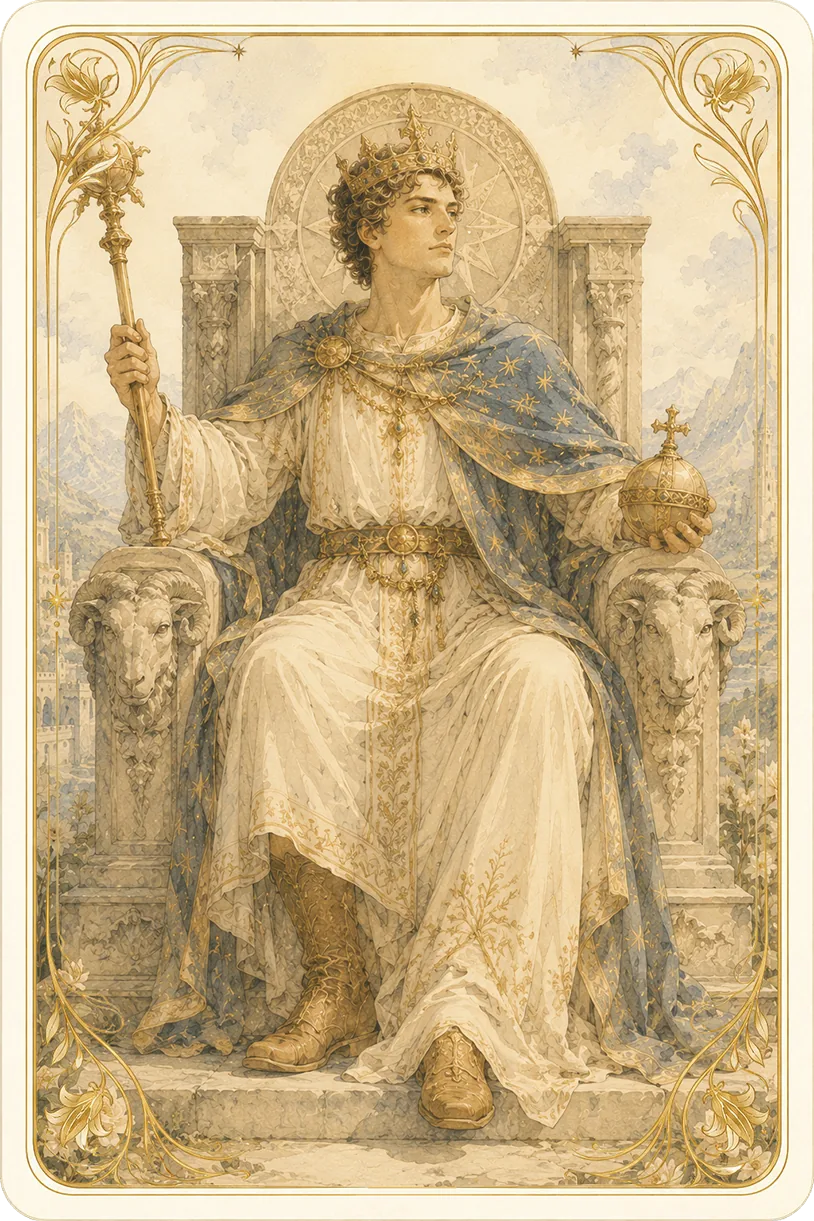
The Emperor
The Emperor deals in structure — boundaries, budgets, who decides what. It appears when a situation needs a frame more than it needs feeling, and often when you're the one expected to build it.
KeywordsAuthority, order, responsibility, stability, control, leadership, structure, practicality
The Emperor sits on a stone throne in armour, and he is not there to be liked. He is the card of structure — boundaries, budgets, who decides what — and he appears when a situation needs a frame more than it needs feeling, often because you are the one expected to build it.
Upright meaning
Your capacity for order is available now. This is less about doing everything you want and more about deciding what you'll protect: the schedule, the standard, the line you won't cross. Written plans and clear roles reduce anxiety here more than reassurance does. A figure with authority may enter the picture — a manager, a father, an institution — and with them, evidence tends to work better than appeal. Taking responsibility is also how you earn a say.
Reversed meaning
Reversed, look at both extremes. Control can harden into rigidity, where everything runs your way until people quietly stop showing up. Or the framework has collapsed — decisions postponed, boundaries unenforced, everyone improvising. Force invites resistance; abdication leaves a mess. A useful question is which piece of this you're holding that someone else could carry perfectly well. Handing that over usually lightens the load without losing the structure.
Love & relationships
Here, stability matters more than intensity. Talking through practical things — how often you see each other, what you're building toward — tends to deepen trust. The risk is turning the relationship into a case to be judged. Ask how your partner feels before explaining what's reasonable.
Work & money
Expect more responsibility, or a role where you're expected to impose order. Careful paperwork, contracts, and process pay off later even when they feel tedious now. Financially, the card favors tightening fixed costs and setting a long horizon over chasing a quick opportunity.
Advice
Name one thing worth protecting, then set a single clear rule today that actually protects it.
What the Emperor card looks like, and why it matters
A bearded figure sits on a grey stone throne carved with rams' heads, wearing armour under a red robe. He holds an ankh in one hand and an orb in the other. Behind him, bare mountains and a thin line of river. There is nothing soft in the image anywhere — no garden, no cushion, no one else present.
The bareness is deliberate. Where the Empress sits in a field, the Emperor sits on rock, and the card is about what rock is good for: it holds. The armour under the robe says authority is a job with a cost, not a comfort. The orb and the ankh say he is responsible for the whole of something, not a part. The Emperor is not the card of power for its own sake. It is the card of the person who has to decide, and who has accepted that deciding is theirs to do.
The Emperor upright: meaning in a reading
Upright, your capacity for order is available now. This is less about doing everything you want and more about deciding what you will protect: the schedule, the standard, the line you will not cross. Written plans and clear roles reduce anxiety here more than reassurance does, and the card's advice is to make the structure explicit — say it out loud, write it down, put a date on it.
A figure with authority may enter the picture — a manager, a father, an institution — and with them, evidence tends to work better than appeal. The Emperor respects the case made well. If the authority in the reading is you, the card's quieter point is that taking responsibility is also how you earn a say. You do not get the throne by asking for it. You get it by being the one who holds things together when no one else will.
The Emperor reversed: what changes
Reversed, look at both extremes. Control can harden into rigidity, where everything runs your way until people quietly stop showing up — the structure is intact and the room is empty. Or the framework has collapsed: decisions postponed, boundaries unenforced, everyone improvising, and the person who should be holding the frame has stepped back from it.
Force invites resistance; abdication leaves a mess. The reversed Emperor's most useful question is which piece of this you are holding that someone else could carry perfectly well. Handing that over usually lightens the load without losing the structure — and often reveals that the grip was about anxiety rather than necessity. The card is not telling you to give up authority. It is telling you to spend it on the things that actually need it.
The Emperor in love and relationships
In love, stability matters more than intensity under this card. Talking through practical things — how often you see each other, what you are building toward, who does what — tends to deepen trust rather than flatten romance. The Emperor describes a partner who shows up, keeps the plan, and means what he says, and for many people that is the whole of what they were looking for.
The risk is turning the relationship into a case to be judged. The Emperor's love can tip into management, and a partner who feels assessed stops being honest. Ask how your partner feels before explaining what is reasonable. If you are asking about someone specific, the card suggests someone steady and slow to open, who shows care through reliability rather than declaration — and who may need to be told, plainly, that you want the declaration too.
The Emperor in work, career and money
Expect more responsibility, or a role where you are expected to impose order on something that lacks it. Careful paperwork, contracts, and process pay off later even when they feel tedious now — the Emperor is the card of the thing you documented that saved you six months on. It favours the person who builds systems over the person who relies on heroics.
Financially, the card favours tightening fixed costs and setting a long horizon over chasing a quick opportunity. It is the card of the budget that actually gets kept, the boring decision made for a reason you could explain to an auditor. The Emperor does not promise wealth. He promises that what you build on rock will still be standing when the quick things have washed away.
The Emperor as a yes-or-no card
Asked yes or no, the Emperor says yes to anything with a structure behind it and no to anything that depends on winging it. It is a confident yes for a plan, a commitment, a role with clear terms. It is a no — or a not like this — for the impulse, the handshake deal, the thing you have not written down. The Emperor's yes comes with a condition, and the condition is that you mean it.
Frequently asked questions
What does the Emperor card mean?
Structure: boundaries, budgets, who decides what. The card appears when a situation needs a frame more than it needs feeling, and often when you are the one expected to build it. It is about deciding what you will protect and making that explicit, and it treats taking responsibility as the way you earn a say.
Is the Emperor a good card?
Good for anything that benefits from order — a plan, a role, a decision that needs making. It is less comfortable when you wanted warmth rather than a frame, because the Emperor leads with the frame. He is not cold; he is the person who holds things together when no one else will.
What does the Emperor mean in love?
Stability over intensity: a partner who shows up, keeps the plan, and means what he says, and whose care comes through reliability rather than declaration. The risk is management tipping into judgment — the card asks you to learn how your partner feels before explaining what is reasonable.
What does the Emperor reversed mean?
Either control hardened into rigidity, where the structure is intact and the room is empty, or a framework that has collapsed into everyone improvising. Its useful question is which piece you are holding that someone else could carry; handing it over usually keeps the structure and loses the strain.
Does the Emperor mean yes or no?
Yes to anything with a structure behind it, no to anything that depends on winging it. A confident yes for a plan or a commitment with clear terms; a not-like-this for the impulse or the handshake deal. The Emperor's yes comes with one condition — that you mean it.
Write your question and pick three cards from the full 78. The first reading works without signing up.
Cards worth reading alongside
Tarot does not fix the future. These pages are a reference for reflecting on where you are right now.