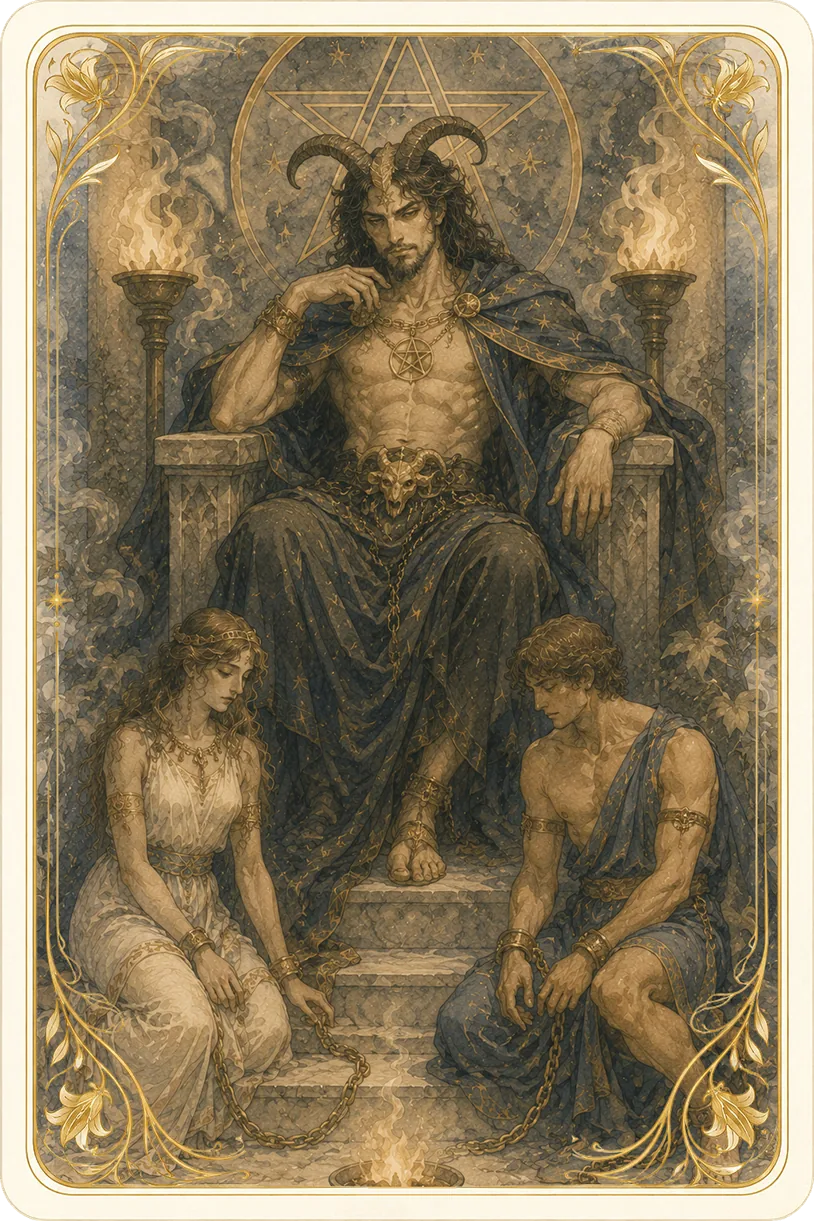
The Devil
About the pull you know is not good for you and stay inside anyway. The card treats attachment as something to examine rather than condemn, and points out that the chain is usually looser than it feels.
KeywordsAttachment, temptation, bondage, desire, addiction, shadow, materialism, awareness
The Devil is the card of the pull you know is not good for you and stay inside anyway. It treats attachment as something to examine rather than condemn — and it points out, every time, that the chain is looser than it feels.
Upright meaning
Something has a strong hold: a person, a spending pattern, a need to be approved of, a habit you have explained away more than once. This card does not moralize about desire, since appetite drives plenty of good things. It asks a narrower question instead. Do you still have a real choice here, or has the choice quietly moved somewhere else? Seeing the mechanism clearly is the part that loosens it.
Reversed meaning
More often than not this reads as the early stage of getting free. You put a name to what has been draining you, and naming it takes some of its power. Expect back and forth rather than a clean exit, and go easy on the self-criticism when you slip. The harder version of this reversal is deepening rationalization, where the story about why it is fine keeps getting longer. Asking for help is not weakness.
Love & relationships
Intense attraction that does not translate into ease. Jealousy, possessiveness, or a connection continuing mostly out of habit can sit behind this card. Worth asking whether the feeling of needing someone is love or fear of the space they would leave.
Work & money
Tunnel vision around money or status. If you are tolerating unreasonable conditions to stay somewhere, writing down your actual reasons is clarifying. Impulsive purchases and stretched borrowing deserve extra caution while this energy is around.
Advice
Before trying to cut something off, write down the hunger it was feeding. That part needs another answer first.
What the Devil card looks like, and why it matters
A horned figure crouches on a black pedestal, one hand raised, the other holding a lowered torch. Chained to the pedestal stand a man and a woman — naked, horned themselves now, with small tails. The scene is dark and the figure is grotesque. It is, on first look, the most frightening image in the deck.
Look at the chains. They are loose. The loops around the couple's necks are wide enough to lift off, and neither of them is trying. That is the whole card. The Devil is not about being trapped by something stronger than you. It is about staying inside something you could leave, because leaving would mean admitting how long you have stayed. The horror in the image is real, but it is the horror of recognition, not of captivity.
The Devil upright: meaning in a reading
Upright, something has a strong hold: a person, a spending pattern, a need to be approved of, a habit you have explained away more than once. The Devil does not moralise about desire — appetite drives plenty of good things, and the card knows it. It asks a narrower question instead. Do you still have a real choice here, or has the choice quietly moved somewhere else?
In a reading the card rarely announces something you did not already suspect. Its work is to name it. Seeing the mechanism clearly — this is what I reach for, this is what it gives me, this is what it costs — is the part that loosens it. The Devil is uncomfortable company, but it is honest, and honesty about a hold is the first thing that weakens one.
The Devil reversed: what changes
More often than not, the reversed Devil reads as the early stage of getting free. You put a name to what has been draining you, and naming it takes some of its power. Expect back and forth rather than a clean exit. Go easy on the self-criticism when you slip; the slip is part of the leaving, not proof that you have failed to leave.
The harder version of this reversal is deepening rationalisation — the story about why it is fine keeps getting longer and more detailed, and the detail is the tell. If you notice yourself building a careful case for something you would never advise a friend to keep doing, that is the reversed Devil at its most dangerous. Asking for help is not weakness. It is the chain coming off.
The Devil in love and relationships
In a love reading the Devil describes intense attraction that does not translate into ease. Jealousy, possessiveness, or a connection continuing mostly out of habit can sit behind this card. It is also, sometimes, simply the card of strong physical desire — and the deck does not judge that. What it asks is whether the desire is running the relationship or running inside it.
The question worth sitting with is whether the feeling of needing someone is love or fear of the space they would leave. Those two feel almost identical from the inside. If you are asking about someone specific, the Devil suggests the bond is real and the cost is real too, and that you already know which one has been winning.
The Devil in work, career and money
At work the Devil is tunnel vision around money or status — the role you cannot leave because of what it pays, the title you are defending at a cost you stopped counting. If you are tolerating unreasonable conditions to stay somewhere, writing down your actual reasons is clarifying. Often the list is shorter than it felt, and one item on it is fear.
With money the card is direct: impulsive purchases and stretched borrowing deserve extra caution while this energy is around. The Devil is the card of the thing you buy to feel better and the debt that outlasts the feeling. It does not forbid the purchase. It asks you to name, before you make it, what hunger it is feeding.
The Devil as a yes-or-no card
Asked yes or no, the Devil leans no — not because the thing is forbidden, but because the card suspects you are asking for permission to do something you already know the answer to. If the question is whether to stay in something that has a hold on you, the Devil says look at the chain. If the question is whether you are free to leave, it says yes, and it has been saying yes for a while.
Frequently asked questions
What does the Devil card mean?
The pull you know is not good for you and stay inside anyway — a person, a habit, a spending pattern, a need for approval. The card does not condemn desire; it asks whether you still have a real choice, and it points out that the chains in the image are loose enough to lift off.
Is the Devil card always bad?
No. It is uncomfortable, because it names something you already suspected, but naming is what loosens a hold. Upright it describes an attachment worth examining; reversed it usually describes the early stage of getting free. It is honest company rather than bad news.
What does the Devil mean in love?
Intense attraction that does not translate into ease — jealousy, possessiveness, or a bond continuing out of habit. Sometimes it is simply strong desire, which the card does not judge. The question it asks is whether the feeling of needing someone is love or fear of the space they would leave.
What does the Devil reversed mean?
Most often, the beginning of getting free: you name what has been draining you, and the naming takes some of its power. Expect back and forth rather than a clean exit. The harder reading is deepening rationalisation, where the story about why it is fine keeps getting longer.
Does the Devil mean yes or no?
It leans no — not because the thing is forbidden, but because the card suspects you are asking permission for something you already know the answer to. If the question is whether you are free to leave something, though, the Devil says yes, and has been saying so for a while.
Write your question and pick three cards from the full 78. The first reading works without signing up.
Cards worth reading alongside
Tarot does not fix the future. These pages are a reference for reflecting on where you are right now.