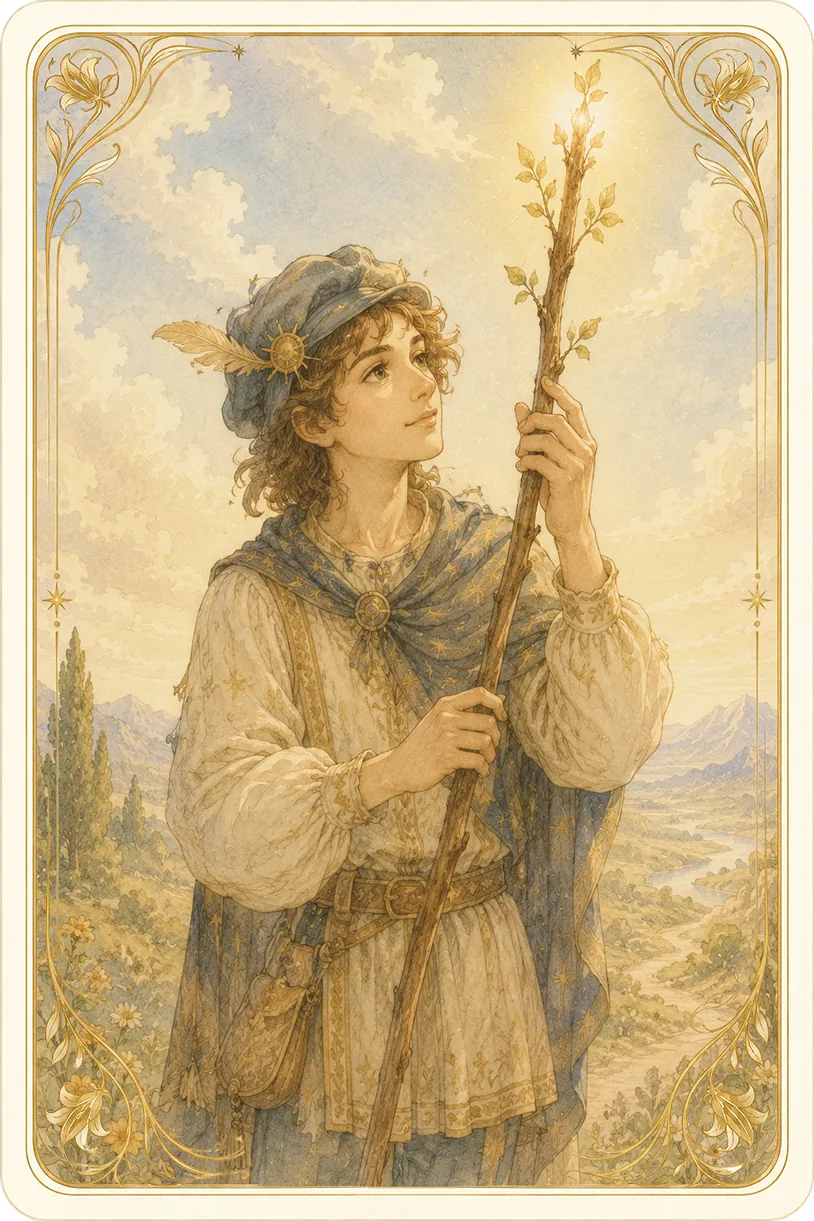
Page of Wands
A young figure studying a sprouting staff, holding an idea that has not decided what it is yet. This card favors starting over polishing, and often arrives alongside news, an invitation, or a fresh curiosity.
KeywordsCuriosity, idea, adventure, passion, news, beginning, exploration, creation
The Page of Wands is a young figure studying a sprouting staff, holding an idea that has not yet decided what it is. The card favours starting over polishing, and often arrives alongside news, an invitation, or a fresh curiosity that does not come with a plan attached.
Upright meaning
An impulse to try something is surfacing, and it does not need a finished plan attached. At this stage a clumsy attempt teaches more than another week of research. Wandering into new subjects, signing up for the class, messaging the person whose work you admire — all of that fits here. The card's whole method is small experiments made before you feel ready, on the theory that readiness arrives through doing.
Reversed meaning
The interest is real but the first step keeps not happening, or it happens and your attention slides to something newer within a week. Notebooks fill; nothing ships. This is rarely a shortage of talent — it is too many directions at once. Taking one small thing all the way to done rebuilds something that scattered enthusiasm cannot.
Love & relationships
Curiosity leads here. Attraction shows up as playfulness, spontaneous plans, and messages sent without much strategy behind them. Nothing has settled into shape yet, and that is fine. Trying to define what this is may cost more than simply letting it stay interesting for now.
Work & money
This suits the beginning of a project or a role where you are still learning. Impatience with your own skill level is common and mostly unhelpful. The person asking the most questions tends to improve fastest — and getting a rough version out beats describing the idea one more time.
Advice
Skip the perfect plan. Do the smallest version of the thing today and learn from what happens.
What the Page of Wands shows, and why every detail matters
A young person stands in a desert, holding a tall staff with both hands and looking up at the fresh leaves sprouting from its top. Their tunic is patterned with salamanders; their hat has a feather. Three pyramids stand in the distance. They are not walking anywhere. They are looking at the staff.
The looking is the card. The Knight of Wands rides; the Page of Wands stands still and examines the thing in his hands, because he has just been given it and does not yet know what it is for. The sprouting leaves say the idea is alive. The desert says it has not been planted anywhere. The Page of Wands is not the card of beginning a project. It is the card of the moment just before — when you are holding something that wants to become something and have not yet decided what.
The Page of Wands upright: meaning in a reading
Upright, an impulse to try something is surfacing, and it does not need a finished plan attached. At this stage a clumsy attempt teaches more than another week of research. Wandering into new subjects, signing up for the class, messaging the person whose work you admire — all of that fits here, and the card treats the wandering as the point rather than a detour from it.
The card's whole method is small experiments made before you feel ready, on the theory that readiness arrives through doing and not before it. It often arrives with news: a message, an offer, an opening you were not expecting. The Page of Wands asks you to receive it with curiosity rather than strategy, and to let the staff tell you what it wants to be.
The Page of Wands reversed: what changes
Reversed, the interest is real but the first step keeps not happening — or it happens, and your attention slides to something newer within a week. Notebooks fill; nothing ships. The staff is still sprouting; the page has set it down to look at another one.
This is rarely a shortage of talent. It is too many directions at once, and the card is gentle about it because the many directions come from real enthusiasm. Taking one small thing all the way to done rebuilds something that scattered enthusiasm cannot — not the idea, but the trust that you can finish one. The reversed Page of Wands asks for one completed thing, however small, before the next beginning.
The Page of Wands in love and relationships
In love, curiosity leads. Attraction shows up as playfulness, spontaneous plans, and messages sent without much strategy behind them. The Page of Wands is the card of the early, light stage where everything is interesting and nothing has been defined — and it suggests that is exactly the right stage for where you are.
Trying to define what this is may cost more than simply letting it stay interesting for now. If you are asking about someone specific, the Page of Wands describes a person who is genuinely curious about you and not yet sure what to do with that — and it says the not-yet is not a problem. It is a page, not a knight; the finding out is the relationship right now.
The Page of Wands in work, career and money
At work, this suits the beginning of a project or a role where you are still learning. Impatience with your own skill level is common under this card and mostly unhelpful — the page is supposed to be learning, and the learning is the job. The person asking the most questions tends to improve fastest, and getting a rough version out beats describing the idea one more time.
The Page of Wands often signals news in a career context: a reply, an interview, an opening. With money, it is the card of the small experiment — the side project, the course, the thing tried at low cost to see whether it has legs — rather than the committed investment. Spend curiosity freely here; spend capital only on what the curiosity confirms.
The Page of Wands as a yes-or-no card
Asked yes or no, the Page of Wands says yes — try it. It is a warm yes for any question about beginning, exploring, or saying yes to an invitation, and it is deliberately silent about outcomes, because a page has not been anywhere yet. If you are asking whether to start, start small and start now. If you are asking where it leads, the card says that is what the starting is for.
Frequently asked questions
What does the Page of Wands mean?
An idea that has not decided what it is yet — the moment just before a project, when you are holding something that wants to become something. The card favours starting over polishing: a clumsy attempt teaches more than another week of research, and readiness arrives through doing. It often brings news or an invitation.
Is the Page of Wands a good card?
Yes, for anything at the beginning. It is warm toward curiosity, experiments, and saying yes to an opening you were not expecting. It is deliberately silent about outcomes — a page has not been anywhere yet — so it is less useful if you wanted reassurance about how something ends.
What does the Page of Wands mean in love?
Curiosity leading: playfulness, spontaneous plans, messages sent without strategy. The early, light stage where everything is interesting and nothing is defined. The card says trying to define it may cost more than letting it stay interesting, and that the finding out is the relationship right now.
What does the Page of Wands reversed mean?
Real interest whose first step keeps not happening, or attention that slides to something newer within a week — notebooks fill, nothing ships. Rarely a shortage of talent; usually too many directions at once. The card asks for one small thing taken all the way to done before the next beginning.
Does the Page of Wands mean yes or no?
Yes — try it. A warm yes for beginning, exploring, or accepting an invitation, and silent about outcomes because a page has not been anywhere yet. If you are asking whether to start, start small and start now. If you are asking where it leads, that is what the starting is for.
Write your question and pick three cards from the full 78. The first reading works without signing up.
Cards worth reading alongside
Tarot does not fix the future. These pages are a reference for reflecting on where you are right now.