King of Pentacles
Built wealth, and the judgment that comes from having built it. The King of Pentacles runs things on experience and numbers rather than instinct, knowing what to protect, what to grow, and what to leave alone.
KeywordsWealth, success, stability, management, practical mastery, investment, authority, abundance
The King of Pentacles is wealth that has already been built, and the judgment that comes from having built it. He runs things on experience and numbers rather than instinct — knowing what to protect, what to grow, and what to leave alone.
Upright meaning
Resources and people are managed together here. The style favors structures that keep working over bets that might pay off, and credibility earned over years starts converting into real opportunity. A signature strength of this figure is pricing the downside before committing — the worst case gets calculated first, not last. From a position of enough, opening doors for the people coming up behind you fits this card particularly well.
Reversed meaning
Net worth quietly begins standing in for self-worth. Reversed, this card raises relationships assessed like assets, authority that has stiffened into inflexibility, and a grip that tightens out of fear of losing ground. The opposite strain appears too: an operation scaled past what its foundation can carry. Writing down what you are actually protecting, and why, tends to sharpen the next decision considerably.
Love & relationships
Affection expressed through provision and reliability — someone who builds the conditions for a shared life instead of describing them. The caution is treating a partner like a portfolio to optimize. Asking how someone feels, before proposing how to fix it, keeps warmth inside the structure.
Work & money
Management, investment, and long-range planning are the themes. No card can say how a market will move, so read this one as guidance about scale: know the edge of your competence, size commitments you could survive being wrong about, and get independent advice on anything large.
Advice
Decide what you could afford to lose before you commit, then move boldly inside that line.
What the King of Pentacles shows, and why every detail matters
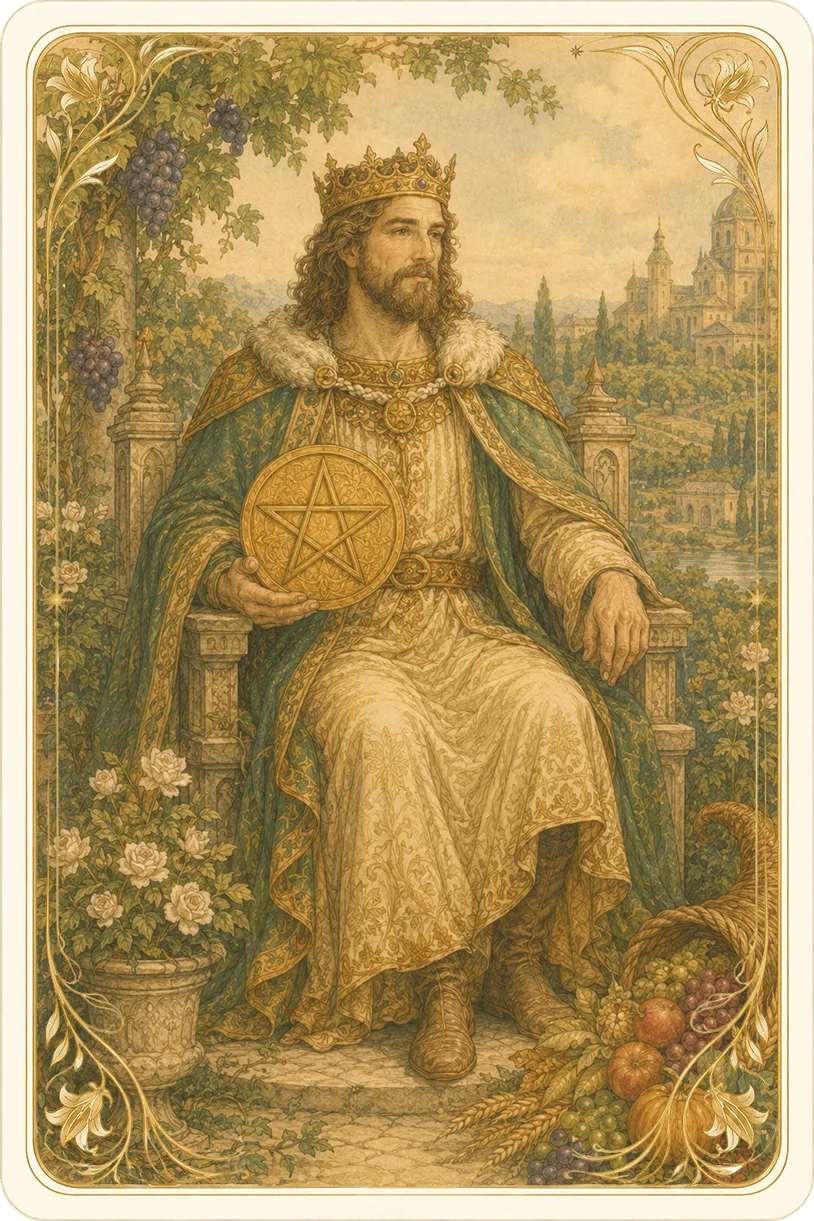
A king sits on a throne carved with bulls, a pentacle resting on one knee and a sceptre in his other hand. His robe is covered in grapevines; the garden around him is full. Behind the throne, a castle. He is not looking at any of it. He looks slightly down and to the side, the way someone does when they are thinking about a decision rather than enjoying a view.
Everything in the image is finished. The vines have fruited, the castle is built, the pentacle is not being reached for but held. This is the only court card whose surroundings say nothing is missing — which is exactly why the figure's attention is on what could go wrong. The King of Pentacles is not the card of getting rich. It is the card of what you do once you have enough.
The King of Pentacles upright: meaning in a reading
Upright, this card describes resources and people managed together, with a style that favours structures that keep working over bets that might pay off. Credibility earned over years has started converting into real opportunity. The signature strength of the figure is pricing the downside before committing: the worst case gets calculated first, not last, and then the decision is made without further hand-wringing.
In a reading it often points to a person — a mentor, an employer, a partner who provides — or to the version of you that has that footing. Either way, the card's quiet suggestion is that from a position of enough, opening doors for the people coming up behind you fits this figure particularly well. Wealth in the King's hands is infrastructure, not display.
The King of Pentacles reversed: what changes
Reversed, net worth quietly begins standing in for self-worth. Relationships get assessed like assets. Authority stiffens into inflexibility. The grip tightens out of fear of losing ground rather than any real threat to it. The opposite strain appears too: an operation scaled past what its foundation can carry, a lifestyle built on income that was never as stable as it looked.
The reversed King is not a villain, though he is sometimes drawn as one. He is someone who forgot what the structure was for. Writing down what you are actually protecting, and why, tends to sharpen the next decision considerably — and usually reveals that some of what is being defended was never worth the cost of the defence.
The King of Pentacles in love and relationships
In love, the King of Pentacles is affection expressed through provision and reliability: someone who builds the conditions for a shared life instead of describing them. Plans get made and kept. Bills get handled. The future is something arranged, not just hoped for. For many people this is exactly the kind of love that counts.
The caution is treating a partner like a portfolio to optimise. Asking how someone feels, before proposing how to fix it, keeps warmth inside the structure. If the card describes the person you are asking about, expect steadiness and a slower emotional pace; if it describes you, ask whether you have been providing in place of listening.
The King of Pentacles in work, career and money
Management, investment, and long-range planning are the themes, and this is a strong card for any of them. No card can say how a market will move, so read this one as guidance about scale: know the edge of your competence, size commitments you could survive being wrong about, and get independent advice on anything large.
For a career question, the King of Pentacles favours the durable path — the role with a real foundation under it over the one with a better title — and it favours becoming the person others come to for the sober read. For a money question, it is the card of the boring, correct decision: the one you will not regret in five years even if you do not brag about it at dinner.
The King of Pentacles as a yes-or-no card
Asked yes or no, the King of Pentacles says yes if the thing is built on something solid, and asks you to go back and check if it is not. It is a confident yes for anything with a foundation — a plan, a savings goal, a steady relationship — and a deliberate pause for anything that depends on momentum alone.
Frequently asked questions
What does the King of Pentacles mean?
Built wealth and the judgment that comes from having built it — someone who manages resources and people on experience rather than instinct, prices the downside before committing, and favours structures that keep working over bets that might pay off. It is the card of what you do once you have enough.
Who is the King of Pentacles as a person?
A provider and a manager: steady, practical, slow to change, generous from a position of security. Often a mentor, an employer, or a partner who builds the conditions of a life rather than describing them. His weakness, when it shows, is mistaking what he owns for who he is.
What does the King of Pentacles mean in love?
Affection expressed through reliability and provision — plans kept, a future arranged rather than merely hoped for. The caution is treating a partner like something to optimise; asking how someone feels before proposing how to fix it keeps warmth inside the structure.
What does the King of Pentacles reversed mean?
Net worth standing in for self-worth: relationships assessed like assets, authority hardened into inflexibility, a grip tightening out of fear. Or the opposite — an operation scaled past its foundation. Writing down what you are actually protecting, and why, usually sharpens the next decision.
Does the King of Pentacles mean yes or no?
Yes, if the thing is built on something solid; a deliberate pause if it depends on momentum alone. It is a confident yes for a plan, a savings goal, or a steady relationship, and a request to go back and check the foundation for anything else.
Write your question and pick three cards from the full 78. The first reading works without signing up.
Cards worth reading alongside
Tarot does not fix the future. These pages are a reference for reflecting on where you are right now.